

You may also be interested in:
Breeding is an important mechanic in Palworld that many players discover as they progress through the game. Much like in the Pokémon games, you can pair two Pals of opposite sexes so they produce an Egg containing a new, potentially stronger creature that can inherit traits from its parents.
In this section of our guide, we will cover everything you need to know about breeding Pals, from what you need at your base to get started to some of the most important valid Pal breeding combinations and the offspring that hatch from the resulting Eggs. Take note!
To breed Pals in Palworld, you must first complete a few specific steps. The first is to build a Breeding Farm at your base. This is the structure where Pals can breed and produce Eggs that will later hatch into new Pals.

The Breeding Farm recipe can be unlocked at level 19 in the Technology menu for 2 Ancient Technology Points. You will need the following resources to build it:
As you can see, these resources are not particularly difficult to obtain. However, make sure to leave plenty of room at your base, as the Breeding Farm is a fairly large structure.
After building the Breeding Farm, you must place a Cake inside the box next to the fence. Without Cake, your Pals will not produce Eggs and the breeding progress bar will not advance. You could say that Cake is what powers the Breeding Farm. We explain how to make it below.

Once you have placed Cake inside the Breeding Farm, you can assign a pair of Pals to the structure. Keep in mind that one must be male and the other female. Two Pals of the same sex cannot breed, although Pals from different species can.
After some time, the two Pals will produce an Egg that you can incubate in an Egg Incubator. When it finally hatches, you will receive a new Pal that may have inherited Active and Passive Skills from its parents and could even have a different element. Remember that if the parents are Lucky Pals, the resulting offspring can be even more powerful.
As mentioned above, breeding in Palworld is not possible without Cake, a type of food that must be placed inside the Breeding Farm. Cakes can be made manually, but you will first need to build a Cooking Pot at your base.
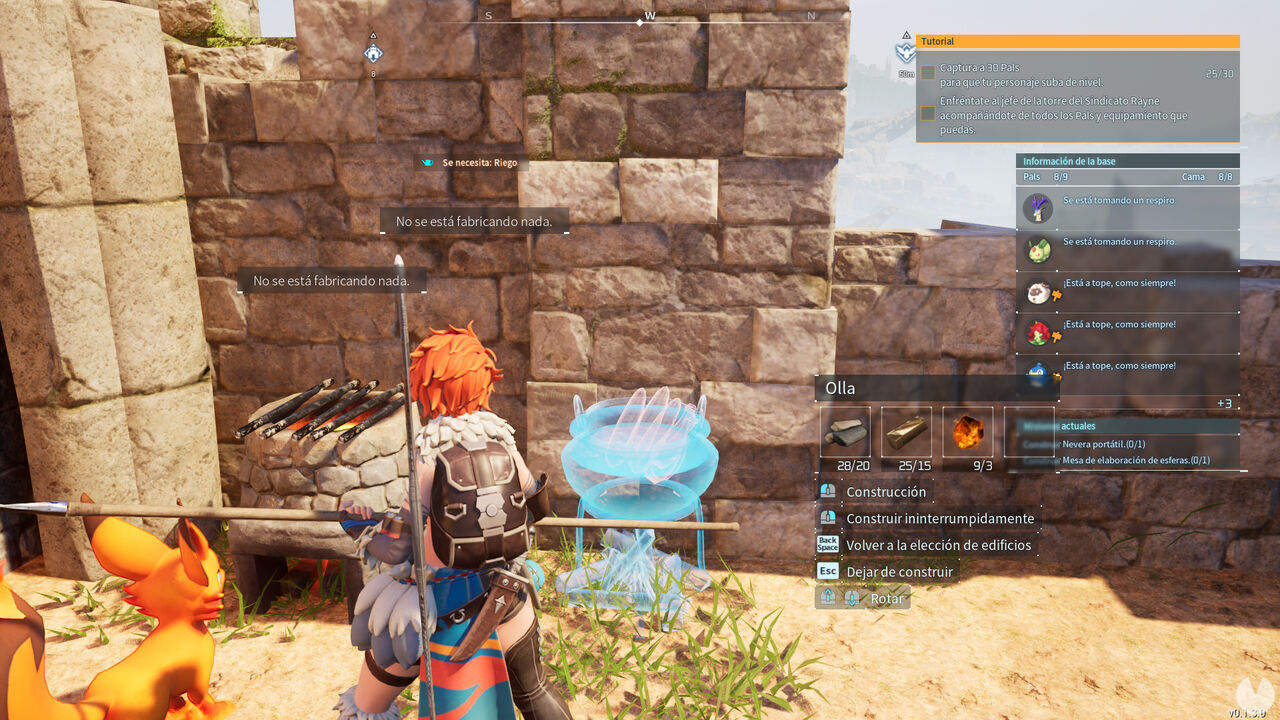
The Cooking Pot is unlocked among the level 17 recipes in the Technology menu and requires Wood x20, Ingot x15, and Flame Organ x3 to build.
You can use this cooking facility to make Cake, among other recipes. To do so, you will need several ingredients. Below, we explain how to obtain each one. Visit the attached links for further details:
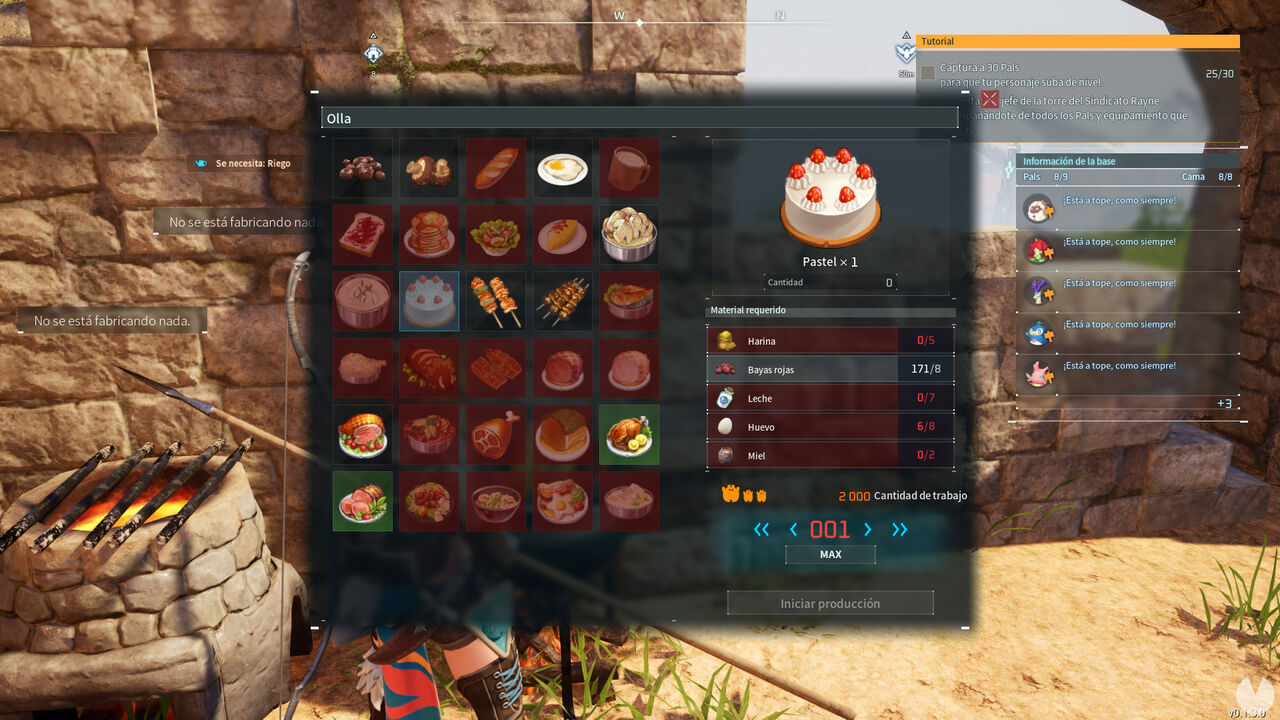
It is worth noting that some of these resources can also be purchased from Wandering Merchants around the world. Flour is probably the most difficult ingredient to obtain, as producing it requires you to build a Mill at your base. Before that, you will also need to plant Wheat Seeds, which can be obtained by defeating Pals such as Cinnamoth, Dinossom, Flopie, Bristla, or Robinquill. You can then grow the Wheat needed to make Flour.
Once you have gathered all these resources, assign a Pal with the Kindling Work Suitability, such as Foxparks, to work at your base. It will then be able to make Cake using the Cooking Pot.
Remember that you will need to make several Cakes if you plan on breeding lots of Eggs, so prepare everything in advance.
When you pair two Pals of opposite sexes at a Breeding Farm in Palworld, their combination will produce a new Pal. The basic mechanic is easy to understand: if you pair two Pals of the same species, such as two Anubis, the offspring will always belong to the same species as its parents—in this case, another Anubis.
However, crossbreeding different Pal species can produce entirely different species. For example, breeding a Penking with a Bushi produces an Anubis. As you can probably imagine, these two parent Pals do not have much in common that would logically explain why their offspring is an Anubis. This is because breeding in Palworld actually uses a hidden numerical system commonly known as each Pal's "breeding power."
The formula behind breeding works as follows:
Still confused? Here is another simple example: Anubis has a breeding power of 570, while Penking has 520 and Bushi has 640. When Penking and Bushi are placed together in a Breeding Farm, the formula described above gives their offspring an average breeding power of 570, exactly the same as Anubis. Anubis will therefore be the Pal that hatches from the resulting Egg.
The same system applies to every other Pal, allowing us to determine in advance which offspring will result from breeding different Pal species.
Below, you can find a list of Pals that can only be obtained through breeding:
These four Pals are exclusive to breeding, meaning they have no locations or habitats in the wild and can only be obtained by pairing the species shown above at a Breeding Farm and incubating the resulting Egg.
Below is a list of all the special breeding combinations that produce Pal subspecies, also known as type variants:
There are 26 Pal subspecies or variants among the game's original Pals, all of which can be obtained by pairing the species shown above at a Breeding Farm. Some can also be found and captured in the wild.
The following six standard Pal species have only one possible breeding combination capable of producing an Egg containing that species:
These Pals have very restrictive breeding combinations, as they can only be produced through the pairings shown above or by breeding two Pals of the same species. However, they can also be found and captured in the wild.
The following Pal species have no crossbreeding combinations. In other words, their Eggs can only be obtained by breeding two parents belonging to the same species:
The following Pal subspecies added in the Sakurajima update have these unique breeding combinations, excluding pairings between two Pals of the same subspecies:
The following Pal subspecies added in the Feybreak update have these unique breeding combinations, excluding pairings between two Pals of the same subspecies:
The following Pal subspecies added in the Tides of Terraria update have these unique breeding combinations, excluding pairings between two Pals of the same subspecies:
