
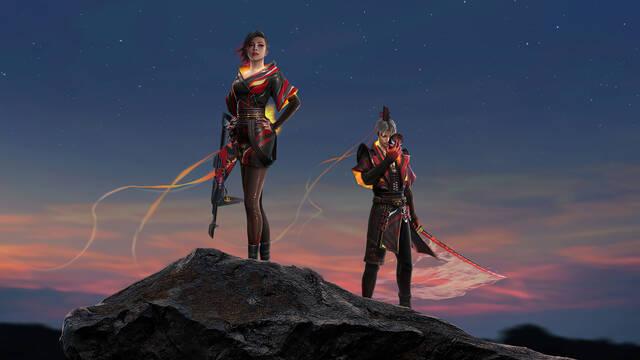
Free Fire is one of the most important mobile battle royale games in the world. Created and published by Garena, it became a global phenomenon thanks to its accessibility, short matches, fast action, and strong focus on mobile players. While other battle royale games often demanded powerful devices or longer play sessions, Free Fire found its identity by offering intense survival battles that could be played almost anywhere, even on modest smartphones.
The official launch of Free Fire took place in 2017, at a time when the battle royale genre was becoming one of the most popular formats in gaming. The idea was simple but extremely effective: dozens of players land on an island, search for weapons and equipment, move inside a shrinking safe zone, and fight until only one survivor or squad remains.
What made Free Fire different was its mobile-first design. The controls, match length, map size, visual style, and performance were all adapted to phones. This helped the game grow especially fast in regions where mobile gaming is more common than console or high-end PC gaming. In many countries across Latin America, Southeast Asia, India, the Middle East, and other markets, Free Fire became not only a game, but a social habit.
The success of Free Fire can be explained by a combination of accessibility, personality, constant updates, and community culture. It was easy to download, free to play, and designed to run on a wide range of devices. This gave it a huge advantage in the mobile market.
The history of Free Fire shows how a mobile battle royale evolved into a long-lasting entertainment platform.
Although battle royale is the heart of Free Fire, the game has expanded with different modes and systems. Clash Squad, for example, offers shorter team-based rounds focused on quick combat, economy management, and coordination. This variety helps the game appeal both to casual players and to competitive users who want more structured matches.
The identity of Free Fire is also strongly tied to style. The slogan-like idea of fighting with personality is visible in its costumes, animations, pets, music events, and collaborations. Players do not only try to win; they also try to express themselves through their avatars and collections.
One of the most important pillars of Free Fire is its competitive scene. The Free Fire World Series and regional tournaments have helped build professional teams, national rivalries, and a strong spectator culture. Because matches are short and explosive, Free Fire esports is easy to understand and exciting to watch.
Today, Free Fire remains one of Garena’s central franchises. Its current strength comes from the fact that it has not stayed frozen in 2017. Instead, it has become a constantly updated service game with new characters, modes, balance changes, collaborations, anniversary events, and esports plans.
The game still faces challenges. Competition in mobile shooters is intense, and players expect better graphics, fair matchmaking, stronger anti-cheat systems, fresh content, and responsible monetization. However, Free Fire has an important advantage: a huge international community and a format that remains easy to understand, fast to play, and highly social.
In the end, the legacy of Free Fire is clear. It proved that a mobile-first battle royale could compete with the biggest names in gaming, build a massive audience, and become a cultural force. Its future will depend on how well Garena balances accessibility, innovation, esports, community trust, and the personality that made the game famous in the first place.
