
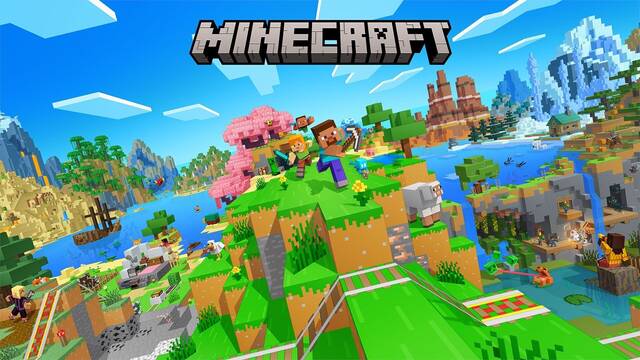
Minecraft is one of the most important video games ever created. At first glance, it looks simple: a world made of blocks, basic textures, and characters with square bodies. However, behind that minimalist appearance is one of the most flexible, creative, and influential gaming experiences of all time. Minecraft is not only a survival game, a building game, or an exploration game; it is a platform for imagination.
The origin of Minecraft is closely linked to the Swedish developer Markus Persson, better known as Notch. In 2009, he began experimenting with a block-based world where players could mine, place materials, and shape the environment around them. The concept was inspired by several ideas common in sandbox and building games, but Minecraft found its own identity by making freedom the center of everything.
Unlike many traditional games, Minecraft did not begin with a fixed story, a long tutorial, or a strict mission structure. The player appeared in a world and had to decide what to do. That freedom became its greatest strength. Some players built houses. Others explored caves. Some fought monsters. Others created machines, cities, sculptures, castles, roller coasters, or entire fantasy kingdoms.
Minecraft first appeared publicly in 2009 and grew through early versions before its official full release in 2011. This gradual launch was essential to its success. Instead of being released as a finished product and then abandoned, the game evolved alongside its community. Players gave feedback, shared videos, created mods, uploaded screenshots, and helped spread the game through word of mouth.
This early community energy made Minecraft feel alive from the beginning. The game was not only something people played; it was something they discussed, modified, recorded, streamed, and taught to others. YouTube and online forums played a huge role in turning Minecraft into a viral phenomenon. Viewers could watch someone build a medieval village, survive a dangerous cave expedition, create a redstone computer, or explore strange multiplayer servers.
The success of Minecraft comes from its extraordinary ability to serve many different types of players at once. It can be peaceful or dangerous, simple or complex, lonely or social, educational or competitive. The same game can be enjoyed by children, adults, casual players, engineers, artists, teachers, speedrunners, and content creators.
The history of Minecraft can be understood as the evolution of a small independent idea into a global entertainment platform.
One of the reasons Minecraft has remained relevant for so long is that it grew beyond its original form. Minecraft: Java Edition became the home of many classic mods and PC communities, while Bedrock Edition helped unify play across consoles, mobile devices, and Windows. Minecraft Education brought the game into classrooms, and the Minecraft Marketplace gave creators new ways to publish maps, skins, textures, and add-ons.
The universe also expanded with spin-offs such as Minecraft Dungeons, focused on cooperative action and dungeon crawling, and Minecraft Legends, which explored strategy and large-scale battles in the Overworld. These projects showed that Minecraft was not only a game, but a flexible visual and creative language.
Today, Minecraft remains one of the biggest games in the world. Its long life is based on constant updates, community creativity, multiplayer culture, and the fact that no two players experience it in exactly the same way. Some treat it as a survival adventure, others as a digital LEGO set, others as a social space, and others as a technical playground for redstone systems and automated farms.
The legacy of Minecraft is enormous. It proved that simple graphics could hide infinite depth, that independent games could change the industry, and that players are not only consumers but also creators. More than a decade after its official release, Minecraft continues to grow because its central promise remains powerful: enter a world, shape it with your own hands, and turn imagination into something visible.
